You're a designer and you're anxious. Claude can generate layouts. Figma's got AI-assisted design. Midjourney makes mockups in seconds. You're wondering if you're about to be expensive clipart.
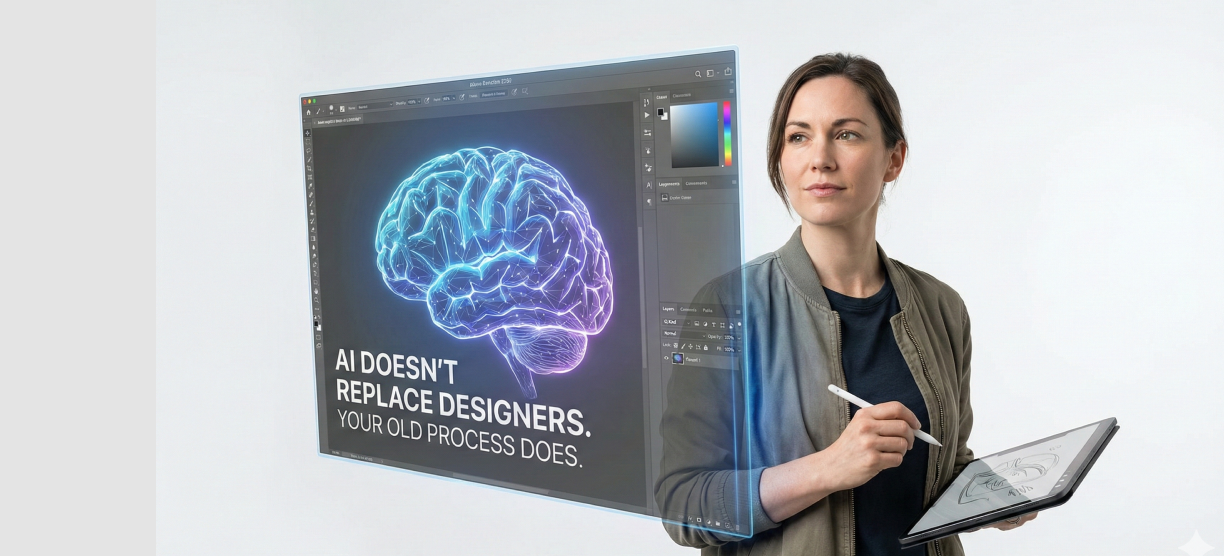
You're not. But your old mental model is definitely obsolete.
The threat isn't AI. It's designers who spend four weeks perfecting a button when they should spend four hours testing ten button variations with users.
🧠 What Actually Changed
For twenty years, design meant: think deeply, make beautiful, ship it, hope it works.
The mental model was built on scarcity. Scarcity of iterations. Scarcity of tools. Scarcity of data. So you got really good at guessing. You got really good at taste. You got really good at defending your vision.
That scarcity is gone.
You can prototype in hours now. You can test with users immediately. You can iterate ten times before lunch. The limiting factor isn't your ability to make things. It's your willingness to stop guessing and start measuring.
AI didn't create this shift. It just made the old way obviously wasteful.
👉 What Matters Now
Stop optimizing for beauty. Optimize for conversion.
Beauty that doesn't convert is waste. Elegant flows that users don't finish are waste. Pixel-perfect systems that no one uses are waste.
A designer in 2026 asks: does this move the user toward the goal? Not: does this look right? Not: does this follow the system? Not: will this impress in the pitch?
Does the user complete the task? Does the checkout happen? Do they sign up? Do they come back?
Everything else is preference.
This doesn't mean ugly works. It means coherence beats polish. Speed beats perfection. Testing beats intuition.
The designer who ships a rough prototype Monday, tests with users Tuesday, and has data-driven changes by Wednesday is doing better work than the designer who spends four weeks perfecting a system nobody asked for.
🚀 Your New Job
You're not an artist anymore. You're an experimenter.
Your job is to translate product questions into testable hypotheses. Fast. When the PM says "we think users will abandon at checkout," you don't spend two weeks designing a new flow. You spend four hours prototyping five variations. You test them. You learn which one actually works. You build that.
You're not designing systems. You're designing answers. And answers need to be tested, not admired.
This is where AI actually helps. Claude can generate variation options. Figma integration can speed up layout iteration. These tools don't replace your judgment. They replace the busywork that was pretending to be design.
You're free to focus on what actually matters: understanding the problem, shipping rough solutions, and measuring what works.
💡 The Skills That Matter
Taste is useful but secondary. Testing is mandatory. Speed is a feature, not a compromise.
You need to think in systems but ship in iterations. You need to understand conversion psychology but not get attached to any single solution. You need to be comfortable shipping something that feels incomplete because completion is a myth anyway.
The designer who can go from question to testable prototype in four hours beats the designer who spends four weeks on a system. Every time.
This is hard to internalize if you spent years becoming good at the old thing. Your taste was your edge. Your ability to defend a vision mattered. Pixel perfection was the job.
That was never really the job. It just looked like it when everything else was slow.
⚠️ What Doesn't Change
You still need to understand users. You still need to know why things work. You still need taste, but taste is now pointed at solving problems, not making things beautiful.
The designers who will be fine are the ones who stop thinking of AI as competition and start thinking of it as grunt work removal. Use it. Ship faster. Test more. Learn what actually converts.
The ones who are in trouble are the ones defending slow processes because those processes made their skills hard to replace.
Your skills aren't going anywhere. Your process is already gone.