MCP for Non-Technical Founders: What You Actually Need to Know
You do not need to understand how MCP works to understand why it matters for your product and your timeline. You do need to understand it well enough to ask the right questions before signing a design engagement.
What MCP is in one paragraph
MCP stands for Model Context Protocol. It is an open standard that lets AI tools like Claude Code directly read and interact with other software, like Figma, instead of relying on a human to translate information between them. Before MCP, a developer had to read a Figma design file and manually recreate its visual properties in code. With MCP, Claude Code reads the Figma file directly and generates code that already reflects those properties. Less human translation. Less drift between what was designed and what gets built.
Why this matters for your product timeline
The traditional design-to-development pipeline has a handoff step in the middle where a developer interprets a designer's Figma file and tries to build something that matches it. That interpretation takes time and introduces errors. Studies of typical product builds have estimated that 30 to 40 percent of visual properties drift between the design specification and the shipped product. Every round of corrections to close that gap is time and money.
An agency using MCP-connected workflows compresses that handoff step significantly. The code starts from a specification the AI read directly, not from a developer's interpretation of a document. Fewer correction rounds means a shorter timeline.
Questions to ask your design agency about MCP readiness
You do not need to know how to set up MCP to ask these questions. The answers tell you whether an agency's workflow reflects the current tooling landscape or the one from three years ago.
Ask: Does your workflow use the Figma MCP server? A yes with a clear explanation of what that means in practice is a good sign. A blank stare or a generic "we use the latest tools" answer tells you something useful.
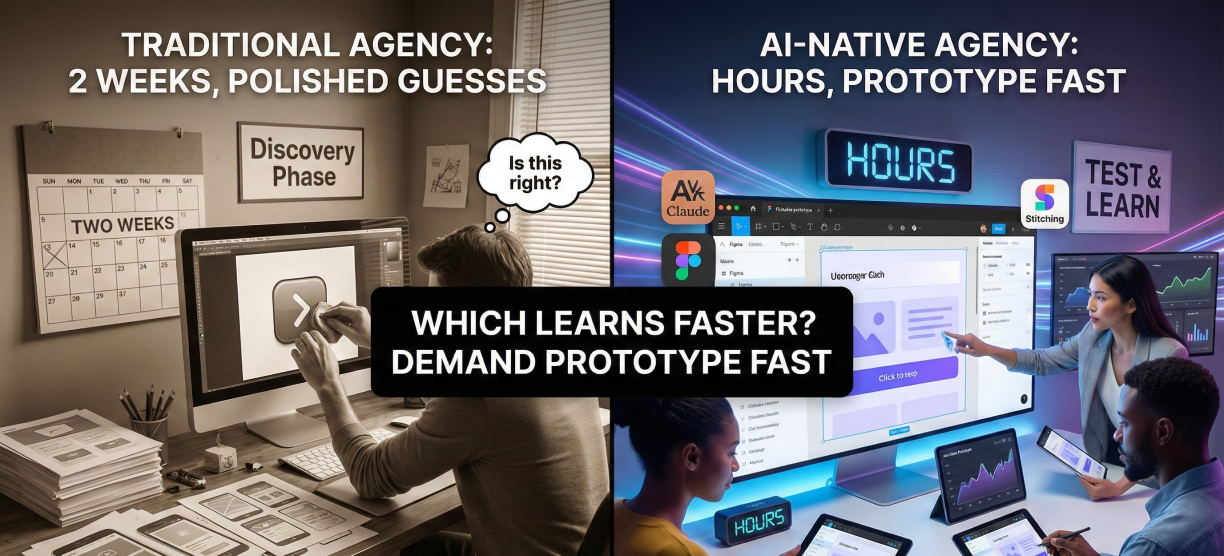
Ask: When will I see something interactive? For a seed-stage product, the answer should be days, not weeks. An agency not using Claude Code and MCP will give you a different answer than one that is.
Ask: How do you handle design-to-code drift? If they describe a process of spec documents and developer review cycles, that is the pre-MCP model. If they describe token-based sync and direct Figma-to-code generation, that is the current one.
What you are still paying for without MCP
Without an MCP-connected workflow, the hours your agency spends on handoff, developer interpretation, and correction cycles are hours billed to your project. These are not hours producing new design decisions. They are hours reconciling the gap between the design file and the implementation.
That gap is structurally unavoidable without the right tooling. It is not a sign of a bad agency. It is a sign of an agency using processes that made sense before MCP existed. The question is whether those processes make sense for your budget now that the alternative exists.
You do not need to understand MCP at a technical level to ask whether your design partner uses it. The conversation that follows will tell you more about their workflow than any capability deck.
.jpeg)