Vibe coding changed who can build products. A founder with Claude Code and a clear idea can ship a working app in a weekend. Real code. Real users. Real feedback. No designer involved.
Some founders are doing this well. They have natural product sense. They understand their users. They ship rough things that work and iterate based on data. For them, skipping a designer at the early stage is the right call.
Most founders aren't those founders. And the line between "scrappy and effective" and "accumulating design debt" is invisible until it's too late.
👉 The Speed Trap
The first version ships fast. Users like the core concept. Metrics look promising. The founder keeps building. Adds features. Adds screens. The app grows. Everything still works. Just... getting harder to navigate.
This is where the trap closes. The product works well enough that there's no crisis. No user is screaming about the UI. But onboarding completion drops from 60% to 45%. Session duration shrinks. Support tickets increase about things that "should be obvious." Conversion stalls.
The founder doesn't connect these to design. They think it's a marketing problem. Or a pricing problem. Or a feature gap. So they build more features. The problem compounds.
By the time they raise a seed round and an investor says "the UX needs work," there's six months of structural decisions baked into the codebase that a designer now has to work around.
🔥 What Founders Get Right
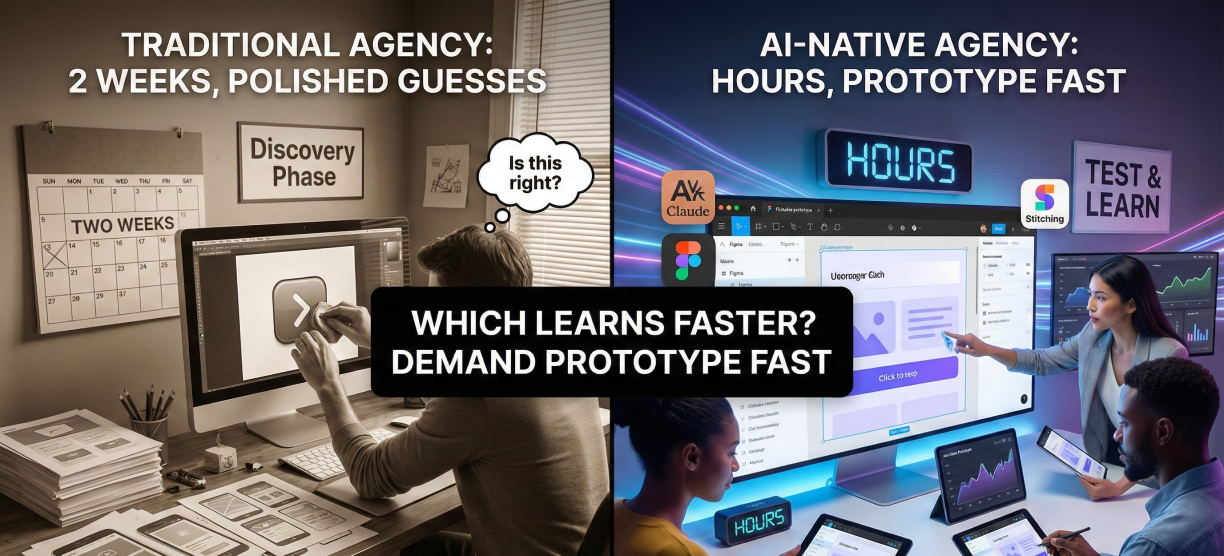
Speed. Founders who build their own products make decisions in hours that take agencies weeks. They don't need to explain their vision to someone else. They don't need to sit through a discovery sprint. They know the problem because they live it.
Directness. Founder-built products tend to be opinionated. They solve the thing they set out to solve without getting distracted by edge cases. That clarity is valuable and hard to preserve once you add team members.
Iteration speed. A founder who can vibe code a change, deploy it, and watch user behavior the same afternoon learns faster than any research process.
🧠 What They Get Wrong
Information architecture. Founders add features where they make sense to the builder, not where they make sense to the user. The navigation grows organically based on development order, not user mental models. By month six, new users can't find things that power users take for granted.
Consistency. Without a design system or even a loose visual language, every screen looks slightly different. Different padding. Different button styles. Different interaction patterns. It works, but it feels unreliable. Users notice this subconsciously even when they can't name it.
Onboarding. Founders understand their product too well to design onboarding for someone who doesn't. They skip steps that seem obvious. They assume context that new users don't have. The activation flow reflects the builder's mental model, not the user's.
Responsive behavior. Vibe-coded products often look good on the screen the founder uses and break on everything else. Mobile is an afterthought because the founder builds on a laptop.
⚠️ When to Get Help
There's no perfect moment. But there are signals.
When your onboarding completion rate drops below 50%. When users ask "where do I find X" more than twice a week. When you're spending more time explaining features than building them. When a friend tries your product and gets stuck on something you've never thought about.
The help you need at that stage isn't a full redesign. It's a focused engagement: someone who can look at what you've built, identify the three biggest UX problems, and fix them without rebuilding everything.
The worst thing you can do is wait until Series A to hire a designer and hand them six months of decisions to untangle. The second worst thing is hiring a designer at day one and slowing everything down.
The right moment is somewhere in between. And it's usually earlier than the founder thinks and later than the designer recommends.